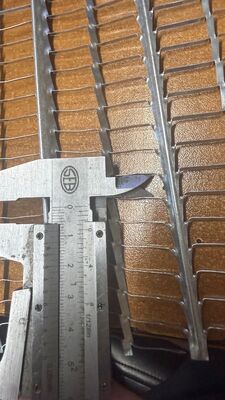
Stainless steel rib lath is produced by punching and stretch-forming 304 or 316L flat sheet into an open diamond mesh, then profiling continuous V-shaped ribs along the running length of every panel. The ribbed section behaves like a shallow beam: it stiffens a light gauge sheet into a self-furring plaster base that holds its shape across a wide stud or furring spacing instead of sagging between fixings.
Where a galvanized lath is expected to blister within a few seasons, the stainless body keeps both its keying apertures and its rib profile intact. Molybdenum-bearing 316L resists pitting under chloride attack, so the same panel can be specified for seafront render, desalination plant rooms, tunnel linings and food factory wash-down walls without a change of drawings. Thickness is held between 0.30mm and 0.50mm, which is heavy enough to survive handling on scaffold yet light enough for a two-man crew to position full sheets by hand.
Key Features
- Stainless 304 and 316L Body: The 316L variant carries 2.0-3.0 percent molybdenum, so chlorides from sea air, de-icing salt or wash-down chemicals do not pit the surface and the mesh stays whole behind the render.
- Continuous V-Rib Profile: Ribs from 4mm to 20mm deep run the full panel length and act as a built-in spacer, holding the lath clear of the substrate so mortar can wrap the strands and form a mechanical key.
- 75-150mm Rib Distance: Rib pitch is selected to suit the furring or stud centres on site, keeping the panel flat under trowel pressure and preventing the low spots that show through thin render.
- 34 to 70 Percent Open Area: The diamond apertures give the plaster enough bleed-through to key on both faces, which raises pull-off strength on ceilings and vertical work alike.
- Sheet Range 200-700mm by 1500-2500mm: Eleven stock widths and five lengths cover bay widths, soffit runs and repair patches, so crews cut less and off-cut waste stays low.
- Mill-Certified Heat Number: Every bundle ships with an EN 10204 3.1 certificate and a heat number traceable to the coil, which is what specifiers ask for on marine and food-grade projects.
Technical Specifications
| Parameter | Specification |
|---|
| Material | Stainless steel 304 / 316L (optional 316Ti) |
| Surface Treatment | Pickled and passivated, mill finish |
| Rib Depth | 4-20mm |
| Rib Distance | 75-150mm |
| Sheet Width | 200-700mm |
| Sheet Length | 1500-2500mm |
| Sheet Thickness | 0.30-0.50mm |
| Open Area | 34-70 percent |
| Mesh Pattern | Diamond strand, V-ribbed |
| Salt Spray Resistance | Over 1000 hours on 316L, ASTM B117 |
| Standard | ASTM F1267, EN 13658-1 |
Applications
The panel is specified for external render on seafront hotels and residential blocks, for soffits and canopy undersides, and for interior wet areas in desalination and water treatment buildings. Because the stainless body does not need a protective coating, it also suits tunnel linings, plant rooms and industrial kitchens where wash-down chemicals would strip a galvanized surface within months.
On restoration work it is used to re-base failed render on masonry and concrete, bridging cracked substrates and giving the new coat a continuous key. Contractors working on listed facades value the fact that the lath can be cut to narrow strips for reveals, cornices and window returns without losing its rib stiffness.
Installation and Handling
Panels are fixed with stainless steel staples, self-drilling screws or tie wire at 150mm centres around the perimeter and along every third rib, with the ribs running across the supporting members. A 10-15mm lap is carried on all edges and the lap is wired at 200mm intervals. Plaster thickness should cover the rib crown by at least 5mm, and two-coat work is recommended on ceilings where the total build is below 12mm.
Sheets should be stacked flat on a dry, level surface with the ribs facing up until installation. Cutting is done with aviation snips or a fine-tooth blade; abrasive discs are avoided because heat discoloration on stainless invites surface corrosion if it is left unpickled.
Packaging and Quality Assurance
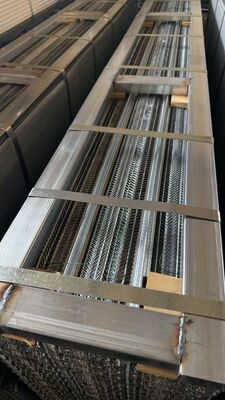
Panels are stacked in bundles of 100 sheets, interleaved with waterproof paper, protected at the corners with plastic edge guards and bound with PET strapping. Bundles travel on fumigation-free plywood pallets, and a desiccant bag is added to each pallet for sea freight. Standard export packing keeps a full 20ft container at roughly 18000 square meters of lath.
Each production lot is checked for rib height, rib pitch, strand width, thickness and open area before packing, and a salt spray sample is pulled from every fifth lot. Documentation includes the mill certificate, dimensional inspection report and a packing list that matches the bundle labels, so incoming inspection on site takes minutes rather than hours.


 Your message must be between 20-3,000 characters!
 English